On average my AI spend has levelled off, and the work I get through each week keeps growing, though more slowly than a year ago. I’m a co-founder of our company, its COO and CTO, and we’re a fintech whose product moves real money. I run AI agents, which are AI models that work through tasks on their own, many at a time and day and night. None of them can move money, and nothing they change goes live unless a person deploys it. Everything they do is reviewed, by tests and by people checking how it behaves. Ramp tracks how American businesses use AI through its own spend data, and it sees a flat line too: its lead economist, Ara Kharazian, reported “two straight months of virtually no growth in token spend,” tokens being the units AI models are billed in. I don’t think either flat line means AI has stopped paying: the next step up comes from a new model, tool or way of working, and that doesn’t necessarily take more tokens. If you’re planning per-person AI budgets to rise with output, you’re planning for hours nobody has.
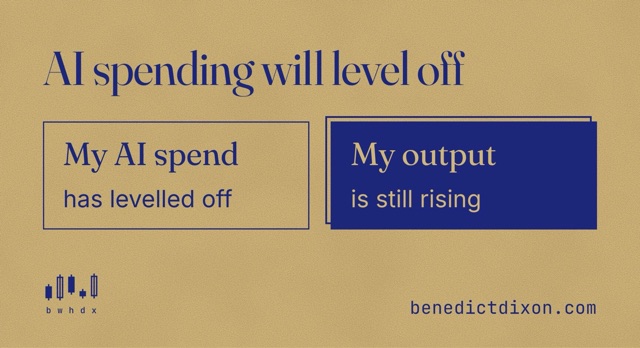
Kharazian’s view of those two months, August and September, is that “the main driver is price declines at the frontier,” and cheaper tokens on the newest models can explain part of it. TechCrunch reported that token spend picked up again in October, up 8.9% from 23 September to 23 October, and quoted Ramp’s economist: “almost the entire spend on AI is from venture-backed, high-growth tech companies.” Cheaper tokens don’t add any hours to anyone’s day, though. My view is that companies are also hitting the limit of what AI returns for them, simply because people are hitting the upper limit of what they can do with it. So I think AI spending will level off, at least per person, and I don’t think the value people get from it will level off with it.
The hours in a day
The upper limit I mean is how much AI one person can put to work, and I think for most people it’s set by time, and sometimes by the RAM and CPU of the machine they work on. On 3 November I wrote that “there isn’t a single second in the day when agents aren’t building something for us.” Their work still has to be reviewed, and review does take our time. To get much more out of agents, a person mostly needs more hours, and short of breaking the laws of physics nobody can add any.
Our AI accounts have upper limits of their own, so it’s fair to ask whether my plateau is just me reaching mine. The limits are there, but not to the point of limiting anyone, and everyone on our team uses AI heavily. When the limit is the machine rather than the day, at the scale of work we’re doing it would be cheaper for us to buy a bigger machine and run agents locally than to run them in the cloud, which costs more and isn’t a sustainable answer for us.
How the ceiling moves
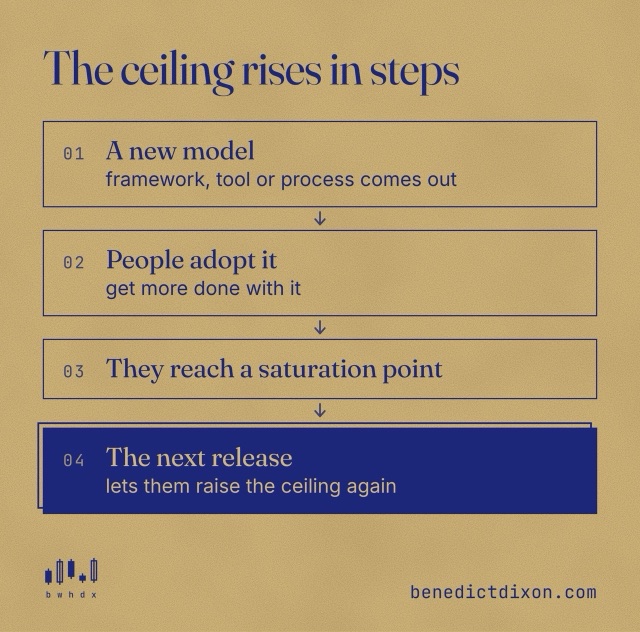
The ceiling rises in steps: a new model, framework, tool or process comes out, people adopt it and get more done with it until they reach a saturation point, and then the next release lets them raise the ceiling again. In February I wrote that “your environment determines your ceiling,” and each of those releases changes the environment. What one person can produce in a week keeps going up, though I’d say probably more slowly than over the past twelve months.
You might expect each step to cost more, if newer models think for longer and need more tokens for each task. A newer model may well need more, and more tokens still help: I’m finding that the more tokens people have, the more work they get done. But a new model or tool doesn’t necessarily mean you’ll need more tokens than you used before to get more done. The ceiling, and what people get done under it, can keep rising without more spending on the tokens themselves, especially as people build new systems with new tools and models. Tokens spent building those systems may help raise the ceiling too.
That is where I’m thinking about the next step for myself. People always make the decisions at our company, and the hours in a day are fixed for all of us, so the question is what to build one level up so we get more through. One possibility is a system that proposes the decisions I would make, which I’d review before any of them is final, so a person still decides. It’s only an idea so far, and I’m still thinking it through.
What to plan a budget around
All of this matters if you’re setting AI budgets per person for next quarter. A budget planned to climb with output assumes people have more hours to spend it in. This month, on average, our own spend has found a good balance. We do spend a lot on AI, though relative to what it returns I’d say we’re conservative with it, and careful with the money. Even so, there are still moments when I could do with more tokens. On 4 November 9to5Mac, reporting Bloomberg, wrote that Apple has begun cutting some employees’ daily AI spending allowances, and that “few workers were using their full $300 daily allowances.” A cut set by what most people use may take tokens from the few who use all of theirs, at the moments when more tokens would get them more work done.