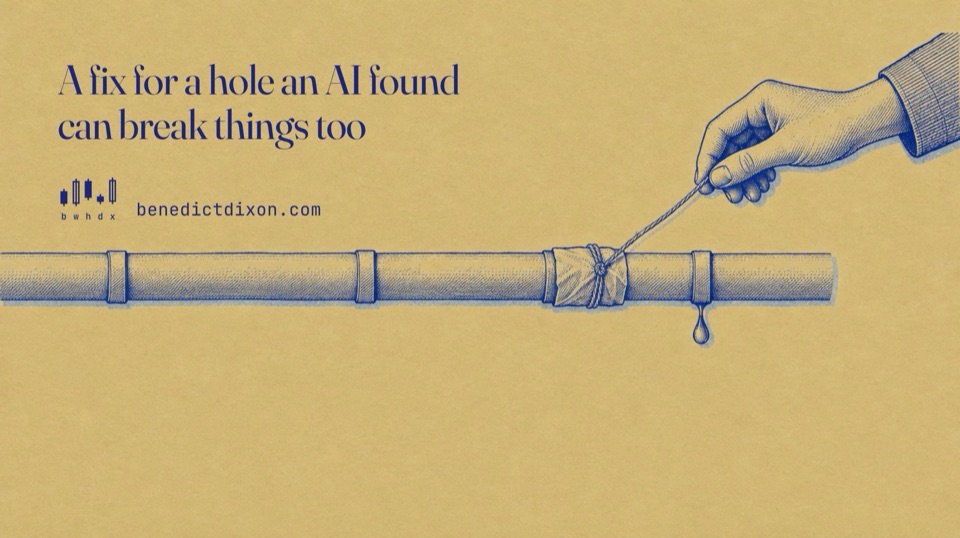
In the week of 16 November, bank customers in the US couldn’t get into their accounts and a highly classified NSA communications network was disrupted, and it doesn’t appear that a cyberattack caused any of it. On 17 November The Washington Sun reported that Wall Street executives and the NSA had told members of Congress, according to three unnamed sources, that the outages came from attempts to fix security holes that AI models had found. “The fixes, however, temporarily overwhelmed the systems,” the paper wrote. The NSA has said a “temporary degradation” of some networks came from “scheduled routine maintenance”. I’m a co-founder of our company, its COO and CTO, and we’re a fintech whose product moves real money. Every change we ship is written by an AI agent, an AI model that works through a task on its own, in our case writing code. None of those changes reaches production, the live system our users are on, until a person has approved it and deployed it by hand. A fix for a hole an AI found gets exactly the same, because a fix is a change like any other, and any change can break something that used to work.
Finding the holes is good news, and there will always be bugs, because it’s impossible for there not to be. So if you build with AI, it’s fair to ask whether checking every fix throws the speed away. A known hole left open looks worse than some downtime, and the Sun reported pressure to patch quickly because attackers may have comparable tools. I agree the holes have to be closed, and we need a greater emphasis on fixing security. But in the Sun’s account the downtime came from the fixes, not from an attacker, and the checks before production are what stop a fix from becoming the next outage.
More patches than the systems were built for
“They’re trying to push through a lot of patches all at once — more than the system was designed for,” a congressional official told the paper, a patch being a code change that closes a security hole. My reading is that we’re not seeing more attacks. We’re seeing more work go through, faster, and it’s turning up a series of bugs in a shorter time frame than we’d otherwise see.
On 17 November, the day of the Sun’s report, the security firm Calif published a serious bug in OpenJDK, the software that runs programs written in Java and, in Calif’s words, the most popular Java runtime. One of its researchers found it by pushing an AI model past mostly useless results until this one turned up. Calif showed the bug could let an attacker run their own code on several widely used Java applications, and Oracle released a patch the same day. I think it’s great. We’re finding bugs, and we’re closing them down. What’s not to love about that? More people are going to have to keep on top of them in the short term, and I think it will start to subside eventually.
What the checks are for
The Sun doesn’t say who or what wrote the fixes behind the outages. My view is about the industry in general: we’re obviously using AI to write security fixes as well as to find the holes, and the models writing them don’t have all of the context. They don’t know what they don’t know, and they sound confident in what they do know. People are pushing out fixes and changes a lot quicker than they would otherwise, and, going by the Sun’s report, things are breaking. I’d expect some of that to be regressions, which is when a change breaks something that used to work.
In the same week the Financial Times reported that KPMG, one of the big four accounting firms, had run more than 100 AI agents on an experimental audit of an unnamed FTSE 250 company, one of the UK’s larger listed companies, alongside the usual audit by its accountants. In several cases “the AI was able to go so much deeper” than the regular audit team, said Cath Burnet, KPMG’s UK head of audit. The report said a human had to step in after an AI agent failed to match a set of regulations to the company’s documents. Using agents for audits makes sense to me, because they process things a lot quicker and in parallel, and they have greater throughput when it comes to reading things. You can’t just take their word for it, though.
Who answers for it
In the same report, Mark Babington, executive director of regulatory standards at the Financial Reporting Council, the UK’s audit regulator, said: “Whatever technology a firm uses, the auditor remains accountable.” It’s the same with code, where an agent is a tool and the person who started that process is responsible for what comes out of it, an urgent security fix included.
At our company every single change is done by an agent. Each one goes through tests and through manual QA, where we check by hand how it behaves and whether its business logic is right, and I approve it before it ships. I’ve scrapped automatic deployment from our systems entirely, so every deployment to production is manual and needs a person to drive it, because for a company like ours it isn’t worth the risk. For the times I’m not available to approve a change, we have backups and contingencies in place.
In the week of 12 October, 117 batches of changes went through our merge queue, the line where changes wait their turn to be combined into the main copy of our code. One merge that week was bad. It was caught in staging, the version of our system where we test changes, so it never reached production.
When one of our users reports a bug, more often than not we make the fix straight away, and it goes out through the same approval and manual deployment as every other change.